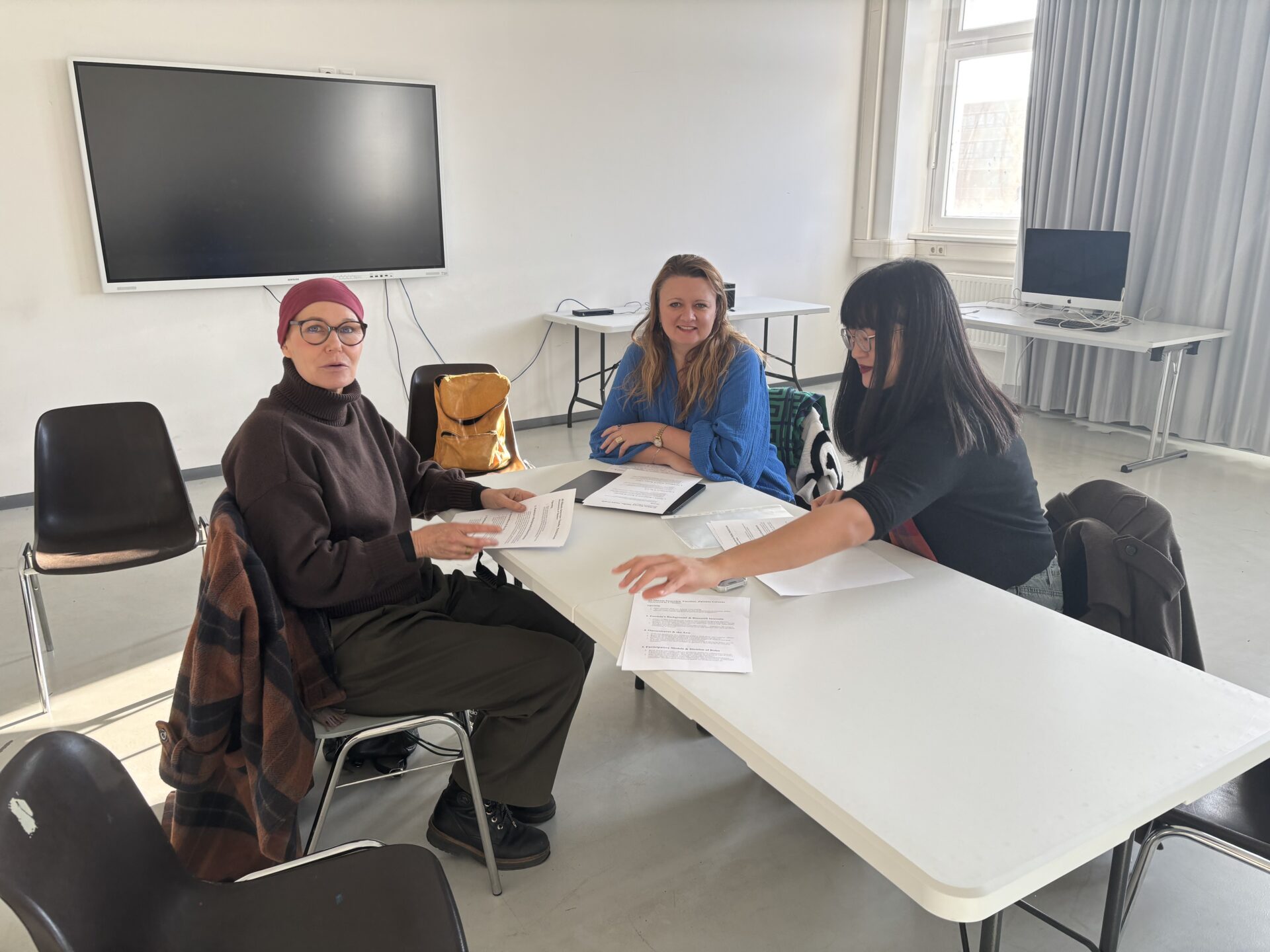
Chang Gao – Patricia, Mathilde and I are really glad you’re here. Before we get into theory or specific projects, I’d love to start more personally. Your work moves between science, the humanities, and lived experience in a very particular way. I’m curious how that began for you. Was there a moment when your research stopped being only academic and became something you were living through, especially in relation to vulnerability and narrative medicine?
Patricia A. Gwozdz – Yes, absolutely. I think the best research often begins with a personal story behind the science. My PhD was already focused on the life sciences, their theory and history, and on popular science and literature. Later, my work shifted more toward vulnerability, and looking back, I think this was already rooted in my family history. My mother had lived with chronic illness, and six years ago she died of cancer.
At the time, I was working on my habilitation, and her illness created a real disruption in my life as a scientist. Life simply came in. During those five months of witnessing her suffering, of moving between doctors, oncologists, psychologists, and the constant struggle between life and death, I realized that my scientific background helped me try to understand cancer—both for myself and in order to explain it to my mother. The doctors told her it would become palliative, but she did not understand what that meant. At one point, she asked me what was going to happen, and I had to tell her that she was going to die.
That moment became a starting point for me, also for writing about it later in my book Die Genesenden (The Convalescents). I am a very rational person, so I needed to rethink this experience through a scientific framework. That helped me survive it. I began to think differently about vulnerability, resilience, suffering, and what it means to share suffering—even to think about the cancer cell itself without hatred. My mother called her cancer cell Hercules.
From there, I began to rethink cancer across biology, medicine, and the life sciences, but also from the perspective of living through it, narrating it, and coping with it. Then, half a year later, COVID arrived, and suddenly vulnerability was everywhere. Everyone was speaking about vulnerable groups. I began to wonder whether vulnerability had a deeper history in the humanities and in human history more broadly.
Around the same time, a friend of mine who is a biologist said to me: “Cancer is the beginning of life.” That stayed with me. How can we fight it so aggressively when the cancer cell also understands how to survive, grow, adapt, and become resilient? That became the starting point for me: rethinking life and death through the cancer cell itself.
Chang Gao – What you’re saying makes me think about trying to look at this from a nonhuman side. Because when someone receives a cancer diagnosis, the first response is usually resistance. You want to stop it, fight it, push it away, because it feels like something inside you is taking over, conquering you. But I keep wondering what happens if we don’t only stay there. What if we ask what is happening from the other side, how the cells are behaving, how they keep growing? That’s something art sometimes allows us to do: to look at things without immediately turning them into a fight. Mathilde, I’m wondering how you think about that.
Mathilde ter Heijne – I am not speaking here as an expert on cancer, but as someone who is currently dealing with this illness. In my understanding cancer isn’t something that is out there trying to conquer a body. It is more like a mistake, a genetic mistake. Something happens in the cell, in its genetic material, something that wasn’t corrected or cleaned up in the way it normally would be, and that is where it begins. If you don’t fight it, cut it out, or diminish these cells in some way, it grows and ultimately it will kill you.
There may be an artistic way of thinking from the point of view of cancer cells. I see an interesting possibility in the cancer cell as a mistake. I teach art, and I often tell students that an artwork begins with a mistake. You do something wrong in your piece, and then you have to embrace that mistake and work around it in order to save the work. Solving the mistake becomes a creative moment, because things do not go the way they should. So one could say that cancer is also a kind of creative moment, something that tries to recreate something. It is just not good for the human body.
Patricia A. Gwozdz – That’s a very good point. And I think this is why some cancer patients give their illness a name: to personalize it, to make it something they can address, almost like a person they can talk to, as my mother did with Hercules. She really talked to her cancer cell. Psycho-oncology also works with this idea, with externalizing illness, speaking to it, creating some form of communication.
When I was thinking about my own project ideas, I felt that this could be a starting point for bringing together the humanities, the natural sciences, and art: to find ways of externalizing what is happening inside the body. Cancer patients mostly see MRI images, these abstract black-and-white forms, and of course now AI can detect cancer earlier and better. But still, something is missing. We need some kind of embodied knowledge — not only to rethink what is happening, but to see it, to relate to it, to talk to it, maybe even to touch it.
We now know that cancer is not simply genetic; it is also epigenetic. It is connected to lifestyle and environment. We live on a vulnerable planet, and that creates vulnerable beings, not only humans but animals as well. Our pets get the same illnesses we do.
Chang Gao – There is an interconnectedness between humans, animals, and the planet.
Patricia A. Gwozdz – Exactly. When the Human Genome Project began, there was a belief that mapping the genome would give us the key to curing cancer, that the so-called war on cancer would be over. But that did not happen. Instead, we began to understand cancer more through processes of switching on and off, as epigenetics suggests.
Some treatments now try to work with this differently — not only through aggressive chemotherapy, but by finding other ways of interacting with the cancer cell. Perhaps there is something like a coexistence between illness and recovery, something in between. I know a French oncologist who thinks about chemotherapy in relation to the timing of the cell cycle.
I once spoke with an oncologist, a family friend, about biological and natural treatments combined with scientific ones. He was skeptical and said he did not think they would work. I kept wondering: why not at least try? Why are doctors sometimes so fixed within their epistemic systems? Of course, he had worked in oncology for forty years and had seen a great deal. But I was interested in why certain approaches are pursued, and others are not.
Cancer is often described as a failure of copies. As cells reproduce, small errors accumulate until something breaks. In that sense, cancer is already connected to the very system of cell division. Healthy cells know when to stop. Cancer cells do not.
This is why I am interested in feminist theory around cancer. Rosi Braidotti writes in Nomadic Subjects that the life of a fetus or embryo is, in a way, similar to a cancer cell: pure cell division. But embryonic cells know when to stop, differentiate, and become a liver cell, a heart cell, or a brain cell. That equilibrium between growth and stopping is one of the mysteries of life. With cancer, the question is how to tell the cells again: please stop. You are destroying the organism.
But even when we speak of “good cells” and “bad cells,” we are already using a human, normative language. I am interested in moving away from that—from good and bad, lethal and living—toward a more neutral way of thinking about these processes.
Chang Gao – That makes me think of a work I saw at the Venice Biennale. A French artist, Pierre Huyghe, used cancer cells extracted from a human body and placed them in a small box. Under controlled conditions, with light, humidity, and nutrients, the cells kept dividing outside the body. The artist used the activity of the cancer cells to generate images projected onto a screen, so the visuals were constantly shifting based on the behavior of the cells. It created a direct connection between the visual form and the cancer cells themselves.
Patricia A. Gwozdz – What is really interesting to me now is not only oncology or the life sciences, but the philosophy of biology. There is an Italian philosopher, Marta Bertolaso, who published a volume called Rethinking Cancer—her PhD, actually—on the philosophy of cancer. What she is doing is something that is often missing in oncology and medicine. I think they are often so focused on a narrow perspective that they miss the larger theoretical picture. That is why philosophy is so important. And this is also where art comes in, especially when artists work together with philosophers and scholars from the humanities. Bertolaso rethinks the history of oncology, combines it with current research, and develops a more nonhuman perspective.
Mathilde ter Heijne – I am also looking into oncology in relation to the arts, especially around the question of how illness is narrated. Illness is very visual. I think the arts are able to approach it from many directions: from the inside, from the outside, through horror, beauty, and transformation.
But of course, that does not do anything to the tumor itself. We can say that positive thinking might help, but we also know people for whom positive thinking did not help. What helped was an aggressive treatment of the cancer. So I see two different directions here: one is the disease inside the body, and the way it can end life. The other is everything that happens around the illness: how life continues, how relationships, language, images, and daily reality change around it.
That is where art comes in for me, in translating illness into the social world.
Patricia A. Gwozdz – For me, art is the best form of science communication. It connects the subconscious and the body and makes it whole. I come from comparative literature, and when I read Audre Lorde’s cancer journals, I loved them. They were part of my first lecture, “Queer Confessions.” Audre Lorde, as a Black lesbian feminist, writes about cancer through activism and lived experience. It is powerful.
But there are also earlier narratives. There is an eighteenth-century German breast cancer autobiography called Ich will aber nicht murren. It was found by feminist historians in an archive in Hamburg and published in the 1980s. I studied German literature and had never heard of it. It is extraordinary. The woman writes letters to her husband and children while undergoing treatment. She had eleven children, several died, and then she developed breast cancer. She describes the treatments in detail. It is the science of its time—brutal science—but also a legacy. She writes so that her daughters will know what might happen to them. In a way, I did something similar with my mother’s diary. We read it together, through the night.
Mathilde ter Heijne – Your mother also kept a diary.
Patricia A. Gwozdz – Yes. She kept a diary about her chronic illness, but also about everyday life: when her daughters came home, Christmas, her garden, all of that. And in between, illness. Then again illness. And finally cancer.
When I read my mother’s diary, I thought: this is a kind of treasure, a legacy. I was observing how she narrated her own story to herself, of convalescence, healing, and suffering again. And when I read this eighteenth-century autobiography, it helped me understand something. I thought: we are all in the same boat.
Then I remembered this passage by Virginia Woolf, one of my favorite moments in A Sketch of the Past. She writes that it is not something that happened to Virginia Stephen at a specific time, but something that happened to a whole legion of women. I read my mother’s diary, then this Enlightenment-era autobiography, and I thought: how many other diaries, letters, and autobiographies by women are still sitting in archives? For centuries, women have been telling these stories, but we do not have access to them.
Chang Gao – During my PhD at the Royal College of Art in London, Care: a PhD Research Group explored pain and illness from a female perspective, highlighting how patriarchal and capitalist systems prioritize productivity and position women as caregivers. Medical systems often center male bodies, neglecting women’s hormonal cycles and experiences. As a result, sick women—especially women with cancer—are frequently overlooked, and their contributions to knowledge are marginalized.
Patricia A. Gwozdz – That is called the gender health gap, or also the gender pain gap. Pharmacology has long focused more on male bodies than female ones.
One of my favorite books on cancer is The Emperor of All Maladies, written by the American oncologist Siddhartha Mukherjee. He even suggests that Cleopatra may have had breast cancer. And of course, the idea of cancer goes back to Hippocrates. They already recognized this kind of swelling, this uncontrolled growth. That is why the history of oncology is so long. Early medical thinkers already knew that there was something in the body that could grow beyond control.
Mathilde ter Heijne – So your mother wrote in her diary every day?
Patricia A. Gwozdz – Yes. She was a very religious person. I come from a Polish background, so Catholicism was very present. And the diary reads almost like the diary of a holy sufferer, like a martyr. I am an atheist, so I do not believe in anything higher. We had many discussions about God and religion.
That is why my habilitation was also about Ecce Homo, Ecce Figura, about Jesus on the cross as the first sufferer in Western religious history. She read so many books about Teresa of Ávila and martyrs, about loving Jesus more through suffering, about suffering as a sign of being loved by God. That triggered me the most. I could not hear it anymore. I thought: I will burn the church down for this. But for her, suffering brought her closer to Jesus.
Mathilde ter Heijne – Well, when the body slows down, one may enter another state, perhaps even one that feels euphoric or heightened. Suffering can be interpreted as leading to another level of consciousness. That seems to me to be a religious idea, but also, in some traditions, almost a kind of technique.
I can imagine that for someone who is spiritually oriented, illness might be understood as a sign to follow that path. I do not think I would choose that interpretation myself, but I find it interesting. In a way, your mother seemed to coexist with her cancer. There was a kind of dialogue between her and the illness. She used it, or understood it, as a way of moving toward another spiritual level.
And that raises the question of dialogue itself: what does dialogue with cancer mean? On what level does it take place? How does one intervene? In some spiritual or animist traditions, for example, healing is also understood in terms of energy flows. Illness is then not only a biological process, but also something connected to emotional, spiritual, or social forces.
So there are many ways of framing a dialogue with illness. And I feel there is a parallel here between you and your mother: she found a religious language for suffering, while you tried to understand it through science, theory, and perhaps also resistance.
Patricia A. Gwozdz – Absolutely. That is why I moved more toward science, while her dialogue was with God and religion. Then she died, and I started writing. I finished the book within a year. It became a dialogue with myself, with Catholicism, with philosophy, art history, and literature. I developed the figure of Ecce Homo from ancient narratives through postmodern theory.
Chang Gao – And from there, it starts to rethink vulnerability, the wound. Before we finish, I want to briefly mention AI in relation to this. The logic of AI is about maximizing outcomes based on existing data. And that reminded me of cancer itself, of how cancer cells also maximize the use of existing resources in order to survive.
Mathilde ter Heijne – So is it imaginary, phantasmagoric, like an ever-growing strange cancer? Or is it real? Do I understand that correctly?
Chang Gao – It is more about how AI generates outcomes. I am thinking about nonhuman consciousness, about how cancer cells or AI use information to survive. I am wondering whether this could be a basis for collaboration between art, science, and technology.
Mathilde ter Heijne – The question is what comes out of it. Science is goal-oriented. Art might open other entrances—emotional, experiential, sometimes transcendental. Vulnerability cannot be measured. It is something you experience.
Patricia A. Gwozdz – What is interesting is that computer scientists also talk about vulnerable systems at the level of AI. Cybernetics, thermodynamics, the idea that everything ends in heat death. But embodiment, the organic body, that is different. Even as we imagine transcending into AI, there is a longing to feel the body again. That is why people seek pain, physical experience, to feel alive.
Mathilde ter Heijne – For me, with cancer, even when I feel emotionally strong, the body does not let you escape. What chemo does is unavoidable. Vulnerability is not a concept you control. It is just there. AI will never have that experience.
Chang Gao – There was also the artist Derek Jarman’s Prospect Cottage in Dungeness, Britain, which is renowned for the sculpture garden he created while living with AIDS-related illness in the 1980s and 1990s. Jarman turned to gardening as a form of therapy and as a creative act of defiance in the face of mortality, creating a garden without walls that merged with the bleak shingle landscape.
It is very beautiful. It is in the middle of the beach, with almost nothing around it—just the sun and the sea. He kept himself busy, and it became his legacy. Now people visit the garden. It is physical, but also spiritual. Plants and sculptures are arranged in a very aesthetic way.
Patricia A. Gwozdz – I just want to thank you all for coming together and for this conversation.
Mathilde ter Heijne – Maybe you have a nice quote from your mother’s diary?
Patricia A. Gwozdz – Yes. There is actually something funny in the diary. My mother’s German was not as good as mine or my sister’s, and she once wrote “mammoth cancer” instead of Mammakarzinom, breast cancer. So it sounded like the cancer of a mammoth, one of the biggest animals. There are moments like that in the diary, unexpectedly funny. I think I would rather remember those than some of the other things she wrote.